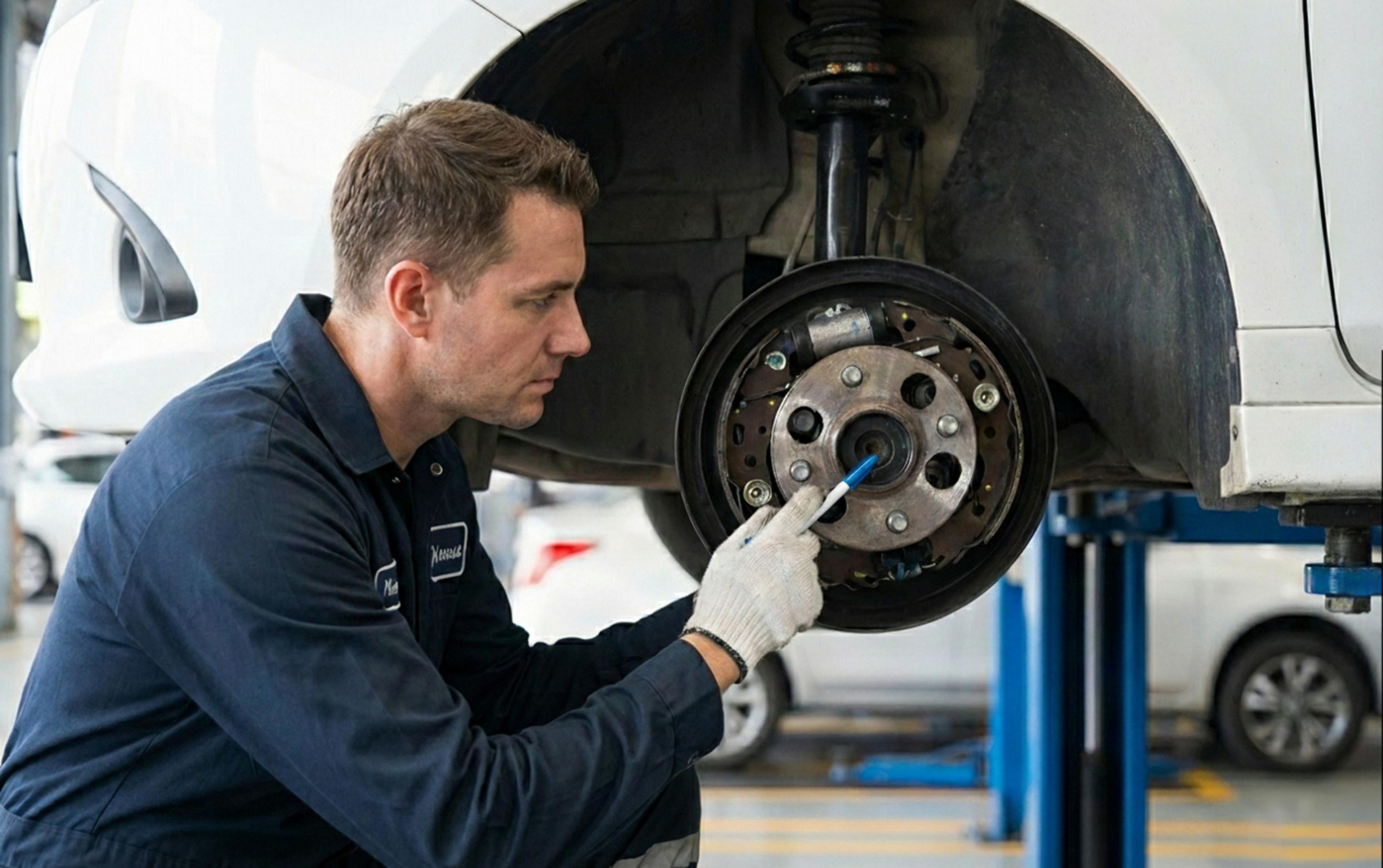
Brake drums as an integral part of modern brake systems
Brake drums continue to play an important role in many braking systems, even though disc brakes are now widely used. Drum brakes continue to be used, particularly on the rear axle of many vehicles. Their robust design, enclosed construction, and consistent braking force make them a proven solution for various vehicle concepts. To properly understand their significance, it is worth taking a closer look at how they work and how the individual components within these braking systems interact.
Functional principle of the drum brake
The brake drum is the central working component of the drum brake and, together with the brake shoes, forms the actual friction chamber in which the braking force is generated. It is firmly connected to the wheel hub and rotates with the wheel while driving. When braking, the hydraulic pressure generated in the wheel brake cylinder causes the brake shoes to press outwards and press evenly against the inside of the brake drums. This friction slows down the vehicle. The brake drum performs several tasks at the same time: it serves as a friction surface, absorbs heat, distributes it, and protects the internal components from dirt and moisture. In modern brake systems, it plays an important role, especially on the rear axle, as it is robust, durable, and low-maintenance.
Structure of the brake drum

Drum body
The drum body is the central component of the brake drum and forms its supporting structure. It is usually made of solid cast iron or temperature-resistant cast alloys so that it can withstand the high frictional forces and intense heat generated during each braking operation. While the vehicle is in motion, the drum body rotates together with the wheel and forms the inner surface against which the brake shoes are later pressed. This smooth, precisely machined inner surface is crucial for even deceleration and stable braking performance. In modern brake systems, the drum body is designed to remain dimensionally stable even under heavy use, as even small deformations could noticeably impair braking performance.
Inner surface / friction surface
The inner surface of the brake drum is where the actual braking process takes place. This is where the brake shoes press outward during braking, creating the friction that slows down the vehicle. For this process to work reliably, the friction surface must remain perfectly round, clean, and free of grooves. If it is damaged, the drum brake may start to judder or brake unevenly. This is also where the self-reinforcement of the drum brake begins: the rotational movement amplifies part of the braking force, which is particularly advantageous for heavy vehicles or trailer brakes. A worn friction surface is a common reason for replacing entire brake drums.
Drum hub / mounting area
The drum hub connects the brake drum precisely to the wheel hub and ensures that it runs absolutely centrally. This is the only way to ensure that the brake shoes are evenly applied. The hub transmits all forces between the wheel and the brake systems, both during braking and during normal driving. It is therefore designed to absorb high torques and braking forces without damage. At the same time, the hub must remain corrosion-resistant, as rust can lead to minimal impact, which in turn causes vibrations or an uneven braking feel. A clean, precisely machined hub area is therefore essential for every drum brake.
Cooling fins
Some brake drums have cooling fins on the outside, which ensure that the heat generated during braking is dissipated more quickly. These fins increase the surface area of the drum and significantly improve heat dissipation, which is an advantage for frequent braking or heavy vehicles. If drums become too hot, the material can expand and the brake shoes grip unevenly, reducing braking performance. That is why many manufacturers use drums with optimized cooling fin geometry for brake systems that are subject to higher loads. Although they are not installed in every vehicle, they significantly increase the durability and stability of the entire drum brake.
Mounting and guide holes
There are various holes or threads on the outside of the brake drum that can be used to attach or remove the drum as needed. These mounting holes are an important but often underestimated part of the design. They enable precise alignment and prevent the drum from loosening or becoming misaligned during operation. If the holes are corroded or worn out, the drum can no longer be mounted correctly, a typical problem with older vehicles that impairs the function of the entire drum brake. A uniform fit also plays an important role here, as this is the only way to ensure reliable power transmission between the wheel, brake shoes, and wheel brake cylinder.
First signs of problems with the drum brake
When brake drums or individual components of the drum brake no longer function optimally, the first thing that usually changes is the braking feel. Typical signs include delayed brake response, slight grinding during driving, or noticeably uneven deceleration. These symptoms often occur when the brake shoes no longer fit snugly or do not retract completely. Sideways pulling during braking can also occur if the drum has worn unevenly or if one shoe is working harder than the other. Many of these changes are only slightly noticeable at first, but worsen over time.

Indications of defects in the wheel brake cylinder
Another clear indication of problems is longer or spongy pedal travel. This effect often occurs when the wheel brake cylinder loses pressure, for example due to corrosion, leaks, or stuck pistons. In such cases, the brake shoes no longer open evenly, which not only reduces braking power but also impairs the overall interaction of the brake systems. If the pressure build-up becomes unreliable, the drum brake reacts late or imprecisely, which can be particularly dangerous in emergency braking situations. Since such defects usually develop gradually, they are often overlooked in everyday use. Regular checks are therefore essential to ensure the long-term functional reliability of the brake drums.
Why brake drums are still relevant
Advantages in everyday use
Despite technical advances in modern braking systems, brake drums remain a relevant component in many vehicles. Their closed design reliably protects the entire mechanism, especially the brake shoes and wheel brake cylinders, from dirt, moisture, and road salt. As a result, drum brakes often wear much more slowly in everyday use than open disc brakes. This system offers a durable and stable solution, especially on the rear axle, where less braking power is required.
Another advantage lies in what is known as self-reinforcement. As soon as the brake shoes are pressed against the drum, an additional friction effect is created which increases the braking effect without requiring high operating forces. This allows drum brakes to work efficiently and evenly. The integrated locking mechanism is also technically simpler and more reliable to implement in brake drums, which is one reason why they continue to be the preferred choice for the rear axle in many brake systems.

Significance in modern vehicle concepts
With the growing use of hybrid and electric vehicles, brake drums are even regaining importance. Since these vehicles generate a large part of their deceleration through recuperation, the mechanical brake is used less frequently. Open systems are then more prone to rust or uneven braking performance. The drum brake, on the other hand, benefits from its protected design. It is less susceptible to corrosion and remains functional even after long periods of inactivity.
Even in modern braking systems, the robust design of the drum brake ensures that important components such as brake shoes and wheel brake cylinders work reliably, even when the system is not under constant load. This makes it a future-proof solution for vehicle classes where durability, low maintenance, and a reliable parking brake function are paramount.
Everyday stresses
Thermal loads
In everyday road traffic, considerable forces act on brake drums. Especially in stop-and-go traffic or when driving with a heavy load, the drum brake operates in short, repeated intervals. This generates frictional heat inside the drum, which can only escape slowly due to the closed design. In contrast to open disc brakes, this causes heat to build up for longer, which puts greater strain on the material. With intensive use, this can lead to slight deformation of the drum or uneven friction contact, which later manifests itself as slightly pulsating braking behavior.
Impact on functional safety
Not only the drum itself, but also the internal components of the brake systems are sensitive to everyday stresses. The brake shoes, which are pressed against the drum during braking, can lose their mobility due to moisture or dirt. Corrosion at the contact points often prevents them from being pressed outwards evenly. This leads to increased pedal travel, uneven deceleration, or a slight grinding noise while driving.
The wheel brake cylinder, the heart of the hydraulic power transmission in the drum brake, also deserves special attention. If dirt or moisture penetrates its seal, the piston can become sluggish or, in the worst case, leak. As a result, the hydraulic pressure no longer builds up correctly, which noticeably reduces braking performance. Since these changes often occur gradually, many drivers only notice the limitations at a late stage, for example through a soft pedal feel or a delayed braking response.
Conclusion
Brake drums are a proven component of modern brake systems and perform their task reliably when all components interact correctly. The drum brake impresses with its closed design, uniform braking effect, and high robustness. Brake shoes, wheel brake cylinders, and brake fluid form a finely tuned system that ensures safe deceleration.
Anyone who understands the function and stresses of brake drums will quickly realize why they still play an important role in vehicle construction today and are a useful addition to disc brakes in many applications.