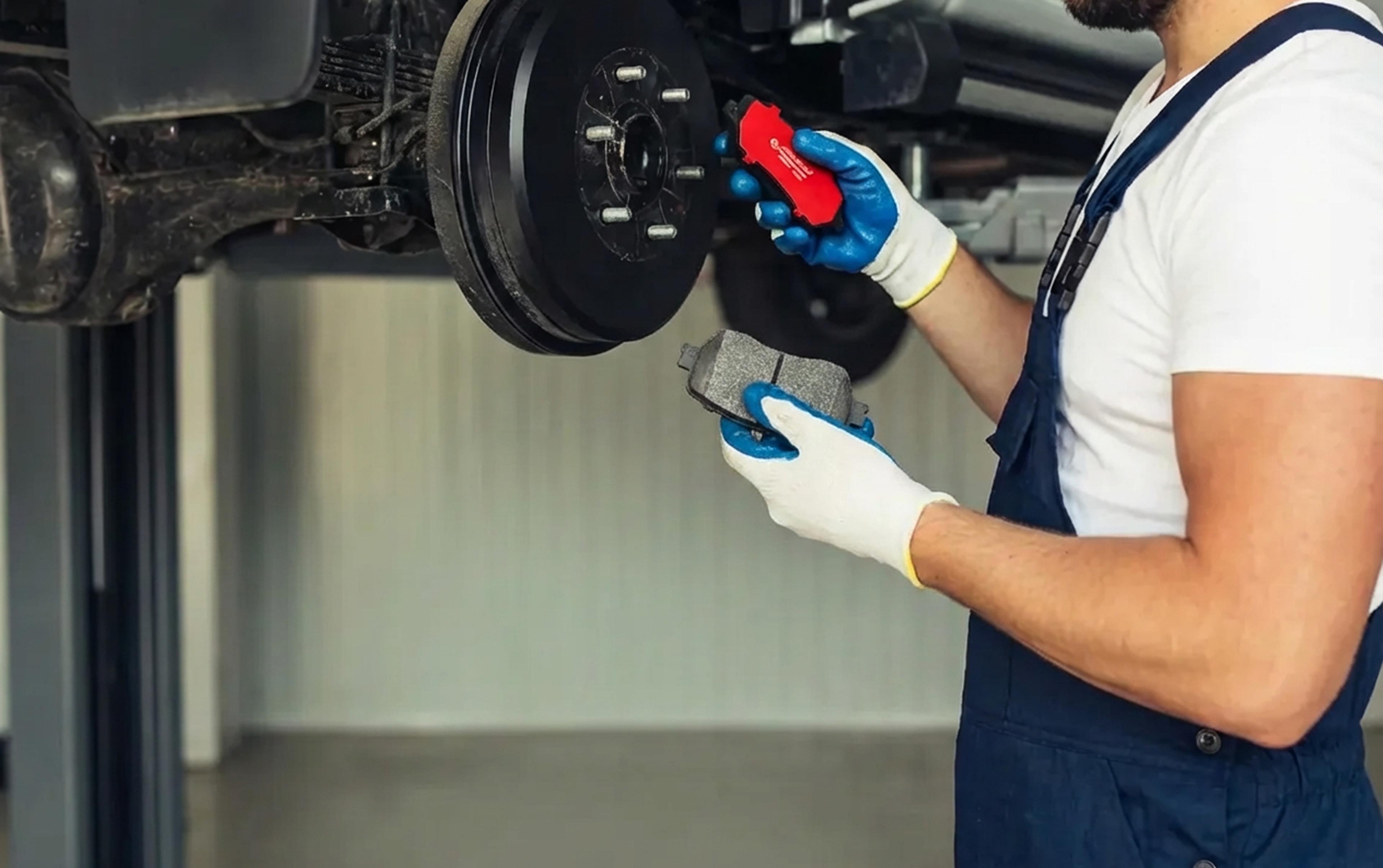
Significance of the brake class
Not every vehicle places the same demands on its braking system. A light small car in city traffic requires a different braking system than a heavy SUV, a fully loaded van, or a sporty vehicle with a high top speed. This is precisely why there are different types of brakes that are specifically adapted to the vehicle's weight, performance, and intended use.
The term "brake class" is often used in this context. This is not an officially standardized classification, but rather a technical requirement class. It describes the performance, thermal stability, and safety reserve that a brake system must meet for a specific vehicle. If you want to understand which brakes are best for which car, you need to understand this context.
What is a brake class?
The brake class describes how powerful a brake system must be designed to safely decelerate a vehicle under realistic conditions. Several factors come into play here.
A key criterion is the weight of the vehicle. The heavier a vehicle is, the more kinetic energy must be converted into heat during braking. This places correspondingly higher demands on brake discs, brake pads, and brake shoes.
The maximum speed also has a significant impact on the brake class. Vehicles that regularly reach high speeds require brakes that remain stable even at extreme temperatures and can withstand repeated heavy braking.
Then there is the intended use. A car that is mainly driven in city traffic places different demands on the braking system than a vehicle with a trailer, high payload, or sporty driving style. For this reason, not every braking system is suitable for every vehicle, even if it would fit mechanically.
Overview of brake types
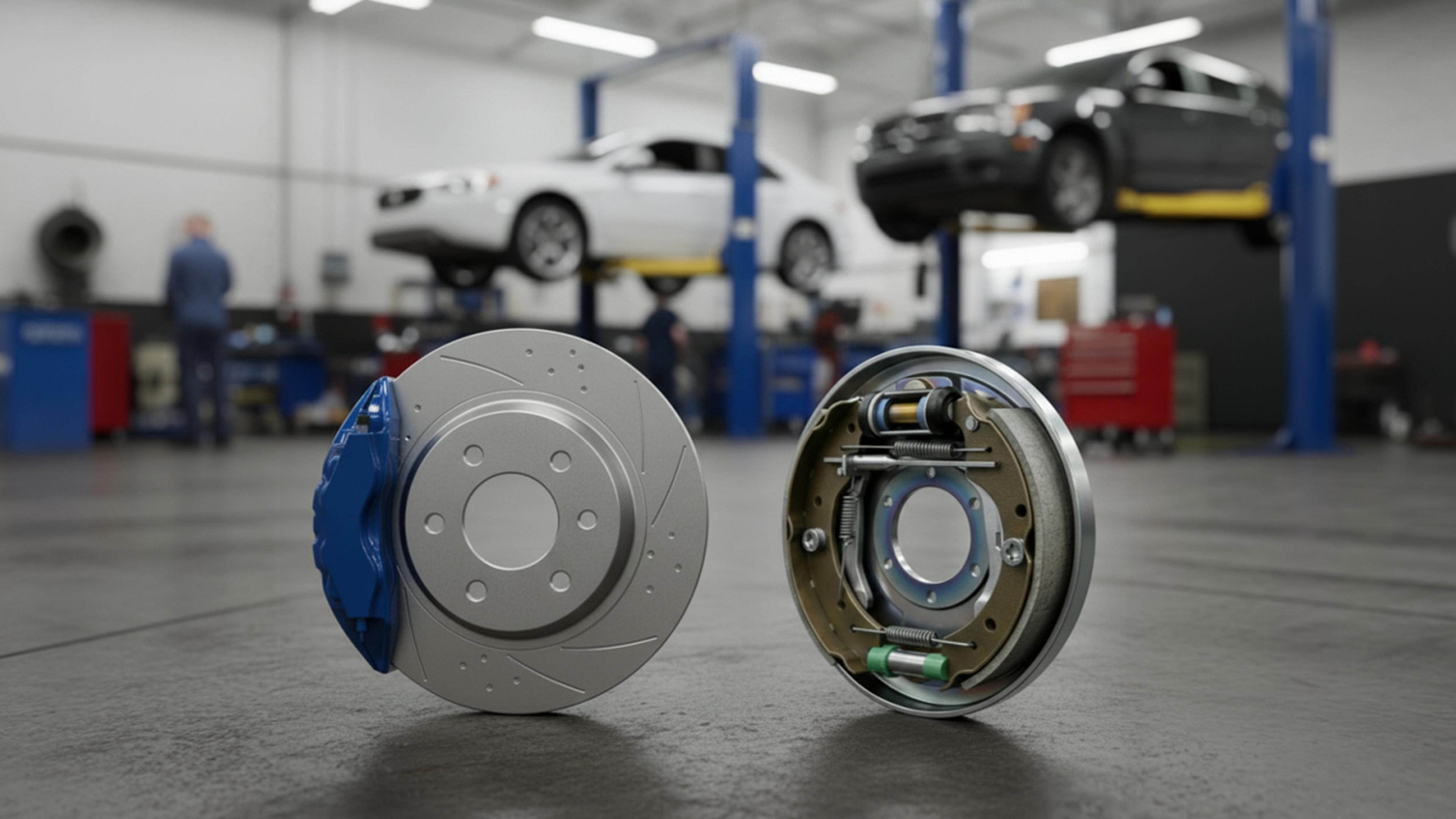
To understand how brake classes are assigned, it is worth taking a brief look at the common types of brakes used in cars. In practice, two systems dominate today: disc brakes and drum brakes. Both perform the same task, but differ significantly in terms of design, behavior, and area of application.
Disc brakes
Today, disc brakes are the dominant braking system in almost every modern brake system and are considered the benchmark when it comes to high braking performance, control, and safety. Their operating principle is based on brake pads being pressed against a rotating brake disc by hydraulic pressure via a brake caliper. The resulting friction converts the vehicle's kinetic energy into heat, thereby slowing the vehicle in a controlled manner.
One major advantage of disc brakes is their open design. The brake disc is exposed to the airflow, which allows heat to dissipate very effectively. This makes disc brakes particularly resistant to overheating and brake fade, even during repeated heavy braking, at high speeds, or with heavy vehicles. For this reason, disc brakes are used primarily on the front axle of almost all brakes in cars, as this is where most of the braking work is done.
In addition, disc brakes offer impressive precision in terms of modulation. Even small pedal movements can be converted into braking force with great accuracy, which is a crucial safety factor, especially in dangerous situations or when driving sportily. Modern variants such as internally ventilated, slotted, or perforated brake discs further improve cooling, friction behavior, and stability.
Drum brakes
The drum brake follows a fundamentally different operating principle than the disc brake, but is still an integral part of many modern braking systems. In this system, brake shoes press against a rotating brake drum, which is firmly connected to the wheel hub, from the inside. The resulting friction slows down the wheel.
A key feature of the drum brake is its enclosed design. This effectively protects the brake system from dirt, water, road salt, and external influences. This results in high durability and low maintenance requirements, especially for vehicles that are used frequently in everyday life, in city traffic, or in changing weather conditions. That is why drum brakes are still used today primarily on the rear axle of many cars, where lower braking forces are required.
Another advantage of the drum brake is its self-reinforcement. The rotational movement of the drum automatically increases part of the braking force, meaning that less hydraulic pressure is required to achieve stable deceleration. This makes the drum brake efficient and consistent under moderate loads.
However, the design weakness of drum brakes lies in heat dissipation. Since the heat generated inside the drum can only escape slowly, they are less suitable for high continuous loads or sporty driving. Under heavy use, temperature build-up and reduced braking performance can occur more quickly.
Nevertheless, drum brakes remain a sensible solution in many braking systems. They are still an economical and technically proven option, especially in vehicles with recuperation, low rear axle loads, or a focus on durability. The answer to "which brakes are the best" therefore always depends on the area of application and not solely on maximum braking performance.
Which types of brakes are used where?
Criteria for evaluation
- Vehicle weight and gross vehicle weight rating
- Engine power and maximum possible speed
- Intended use of the vehicle (city driving, long-distance driving, towing, sports)
- Frequency and intensity of braking maneuvers
- Maintenance requirements and desired service life
- axle load distribution
Small and compact vehicles
Small and compact vehicles generally have a low vehicle weight, compact dimensions, and relatively moderate engine power. Accordingly, the demands placed on the braking system are manageable, as extremely high deceleration forces or sustained thermal loads rarely occur in everyday use. Typical applications include city traffic, country roads, and moderate speeds.
This vehicle class usually features a combination of disc brakes on the front axle and drum brakes on the rear axle. This configuration makes optimum use of the physical weight shift that occurs during braking. When decelerating, most of the vehicle's mass is shifted forward, which means that the front axle takes on the majority of the braking work. The disc brake offers good controllability, fast response, and sufficient thermal stability.
The drum brake on the rear axle operates under significantly lower loads. Its enclosed design protects the mechanics from dirt and moisture, resulting in a long service life and low maintenance requirements. For these brakes in cars, this brake class is completely sufficient, reliable, and economically viable for everyday use.
Mid-range and family vehicles
As vehicle size, curb weight, and engine power increase, so do the demands placed on the braking system. Mid-range and family vehicles are often driven with multiple passengers, luggage, or child trailers and are regularly used on highways or expressways. This results in higher speeds and significantly greater braking energies.
For this reason, disc brakes are usually installed on the front and rear axles in this vehicle class. Internally ventilated brake discs are also frequently used, especially on the front axle. This design significantly improves heat dissipation and ensures that the disc brakes remain stable and consistent even during repeated braking maneuvers.
The advantage of this brake class lies in its higher thermal reserves, shorter braking distances, and an overall superior braking feel. Especially on longer journeys, at higher speeds, or with heavier loads, braking performance remains consistently available. For many drivers, this equipment represents an optimal compromise between safety, comfort, and durability, and sets the current standard for brakes in mid-range cars.
SUVs and heavy vehicles
SUVs, off-road vehicles, and other heavy vehicles have a significantly higher mass and center of gravity due to their design. When braking, this results in considerably greater forces acting on the braking system, especially during emergency braking or when driving downhill. At the same time, there is an increased risk of overheating if the brakes are not sufficiently dimensioned.
This vehicle class is therefore typically equipped with larger brake discs, powerful disc brakes on all wheels, and often ventilated or slotted brake discs, which enable particularly effective heat dissipation. These systems are designed to safely absorb high braking energies and remain dimensionally stable even under heavy use.
Drum brakes are rarely used in SUVs and heavy vehicles anymore, as they do not offer the necessary thermal resilience. For this class of vehicle, a high-performance disc brake is essential to ensure short braking distances, stable deceleration, and safe handling. In this segment, the question of "which brakes are best" can be answered clearly in favor of high-quality disc brake systems.
Commercial vehicles and vans
Commercial vehicles and vans place special demands on the braking system. They are designed for high continuous loads, changing loads, and long operating times. Brakes must not only absorb high forces, but above all function reliably and evenly over many kilometers.
Reinforced disc brakes are often used in this vehicle class, sometimes supplemented by special drum brakes on the rear axle, especially for heavy loads or trailer operation. These drum brakes are often larger in size and designed for high stability. The focus is less on sporty precision and more on durability, even wear, and robust function in everyday work.
For commercial vehicles, the reliability of the brakes in the car under changing conditions is particularly important. That is why braking systems are designed to be particularly conservative, with generous safety reserves and durable components that work reliably even under heavy use.
Sporty vehicles and performance classes
Sporty vehicles and performance models place the highest demands on the braking system, as they are regularly driven at high speeds, with strong acceleration and extreme deceleration. In this segment, brakes are not only relevant to safety, but are also a key performance component that determines vehicle control, lap times, and driving experience.
This brake class typically features large, internally ventilated brake discs, often supplemented by perforated or slotted designs that enable particularly rapid heat dissipation. Multi-piston calipers are also used, which distribute the braking pressure evenly across the entire pad surface. This ensures consistent braking performance even at extreme temperatures. The system is complemented by high-performance brake pads, whose friction material is specially designed for high thermal loads and precise controllability.
In performance vehicles, the focus is less on maximum service life and more on reproducible braking performance under all conditions. Even after several emergency braking maneuvers or on the racetrack, the braking system must respond in exactly the same way, without fading, pedal travel change, or uneven deceleration. For this reason, materials are used that can withstand high temperatures but may wear out more quickly.
Electric and hybrid vehicles
Electric and hybrid vehicles place new technical demands on the braking system, as a large part of the deceleration is no longer purely mechanical. Through a process known as recuperation, kinetic energy is converted into electrical energy during braking and fed back into the battery. As a result, conventional brakes are used much less frequently in these cars than in vehicles with combustion engines.
This change in usage leads to several special features. On the one hand, mechanical wear on brake discs and brake pads is significantly reduced, as many braking operations are performed purely electrically. On the other hand, open systems such as disc brakes are more susceptible to corrosion because the friction surfaces are not regularly "freed up" by braking. This can result in rust, uneven pad contact, or components sticking.
For this reason, drum brakes on the rear axle are regaining importance in electric and hybrid vehicles. Their enclosed design reliably protects the brake system from moisture, dirt, and road salt. Even with infrequent use, the brake shoes and mechanics remain functional and evenly mobile. For this vehicle class, the drum brake therefore offers clear advantages in terms of durability and reliability.
In modern braking systems for electric and hybrid vehicles, drum brakes are used specifically where low braking loads, long service life, and corrosion protection are key considerations. The combination of recuperation on the front axle and robust drum brakes on the rear axle shows that even tried-and-tested braking systems still have their place when adapted to new vehicle concepts.

Why the right brake class is crucial
Choosing the right brake class has a direct impact on safety, handling, and the actual braking distance of a vehicle. Every brake system is designed for specific loads, depending on vehicle weight, engine power, area of use, and driving style. If a brake system is too small or incorrectly dimensioned, it will reach its physical limits more quickly. This results in excessive heat build-up, reduced braking performance, and uneven wear on individual components.
An undersized disc brake can overheat during repeated braking and lose its effectiveness, while an overloaded drum brake dissipates heat insufficiently and thus loses precision. In both cases, the braking distance is extended, the pedal feel becomes spongy, and control over the vehicle is noticeably reduced. Such effects can be critical to safety, especially in an emergency.
A correctly designed brake class, on the other hand, ensures thermal stability, even force distribution, and predictable, reproducible braking performance. The brakes in the car respond evenly, the pedal feel remains constant, and the components wear in a controlled manner. This not only increases safety but also extends the service life of the entire brake system.
Against this background, there is no blanket answer to the frequently asked question of "which brakes are the best." The best solution is always the one that best suits the vehicle concept and actual use. City vehicles benefit from durable, low-maintenance systems, while powerful vehicles or heavy vehicle classes rely on heavy-duty disc brakes. The decisive factor is not the maximum braking performance on paper, but the design of the braking system in real everyday driving.
Maintenance
A higher brake class does not mean that a brake system is maintenance-free. Regardless of whether a vehicle is equipped with powerful disc brakes or robust drum brakes, all brakes in a car are subject to continuous wear and tear. Different designs react very differently to stress, driving style, and environmental influences.
Particularly in higher brake classes, significantly greater thermal and mechanical forces act on the components. Brake pads, brake discs, or drums must be precisely matched to each other so that the originally planned braking performance is actually achieved. If unsuitable or inferior quality replacement parts are installed, the effective brake class can deteriorate significantly, even if the brake system is designed to be powerful. For example, mismatched brake pads can lead to uneven friction, which increases heat generation and accelerates wear in both disc brakes and drum brakes. Similarly, unsuitable brake discs or poorly manufactured drums impair power transmission and lead to longer braking distances, vibrations, or an unstable pedal feel. In such cases, the brake system loses some of its safety reserves, even though on paper it corresponds to a higher brake class.
Conclusion
The importance of the brake class lies in consistently adapting the brake system to the vehicle concept and actual use. Whether disc brakes or drum brakes, no type of brake is fundamentally better or worse, but only more suitable for certain requirements. Light vehicles with moderate power requirements can reliably manage with simpler brake solutions, while heavy, fast, or heavily loaded vehicles require powerful and thermally stable brake systems.
The decisive factor here is not only the maximum braking power, but also the interaction between vehicle weight, speed, usage profile, and maintenance condition. A correctly designed brake class ensures consistent braking performance, short braking distances, and controllable wear. If, on the other hand, the brake system is incorrectly dimensioned or operated with unsuitable components, it quickly loses safety and efficiency.
If you want to understand which brakes are best for your car, you should therefore not just look at individual components, but always consider the brake system as a whole. This is the only way to ensure safe, reliable, and vehicle-appropriate deceleration in the long term.