How brake shoes work in drum brakes
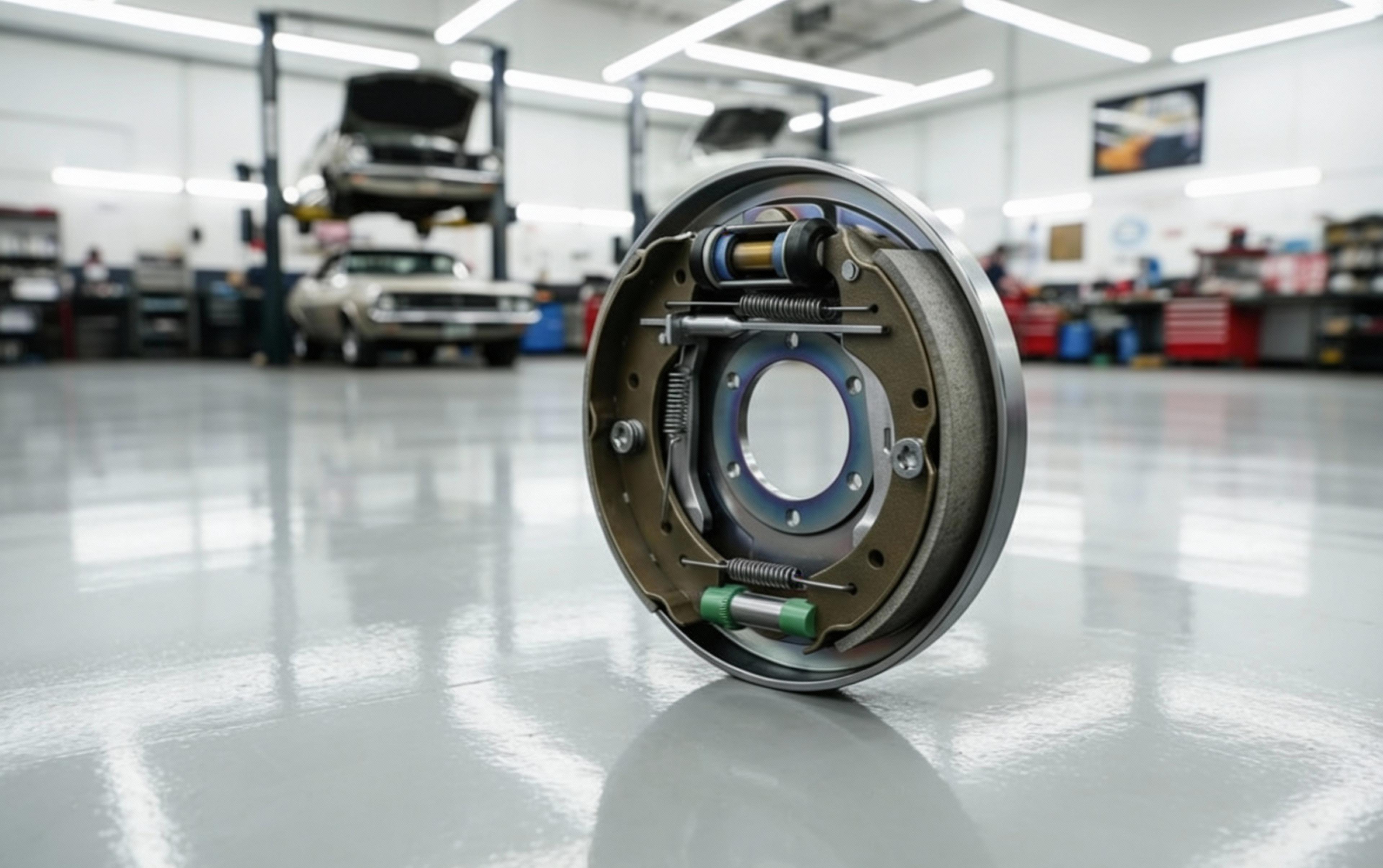
The brake shoes are the central active components of a drum brake. As soon as the driver presses the brake pedal, the hydraulic brake system builds up pressure, which is transferred directly to the brake shoes via the wheel brake cylinder. The wheel brake cylinder pushes its pistons outwards and spreads the two brake shoes symmetrically against the inside of the rotating brake drum. This frictional contact creates the braking effect. The kinetic energy of the vehicle is converted into heat, which slows down or completely stops the wheel. Throughout this process, the brake shoes must be guided precisely so that they apply evenly and do not introduce any unilateral forces into the brake system. After the brake pedal is released, powerful return springs pull the brake shoes back to their original position so that they are free of the drum and do not rub. This harmonious interaction between the brake shoes, wheel brake cylinder, and brake drum makes the drum brake a robust, reliable braking system that is used particularly on the rear axle of many vehicles.
Structure of a brake shoe
Support structure
The carrier body is the foundation of every brake shoe and forms the robust basis on which all other components of the drum brake are built. It is usually made of solid sheet steel or high-quality cast material, which is shaped in such a way that it can evenly absorb and distribute the high forces in the braking system. During braking, the wheel brake cylinder exerts pressure on the brake shoes and spreads them against the inner surface of the brake drum. The carrier body must remain absolutely dimensionally stable, as even the slightest deformation has a direct effect on the braking performance. Uneven contact of the brake shoes leads to longer braking distances, uneven deceleration, or even fading.
Corrosion, material fatigue, or manufacturing defects can compromise the stability of this component. Even thin layers of rust can alter the fit in the brake shield or weaken the structure. The carrier body in the brake system is therefore classified as a safety-critical element; without a perfectly shaped and resilient carrier body, no brake system can generate braking force reliably and consistently.
Friction lining
The friction lining is the key factor in the braking effect of a drum brake, as this is where direct friction contact with the brake drum occurs. This material must withstand extreme conditions: strong compressive forces, high temperatures, and changing environmental conditions. Modern friction linings consist of complex composite materials such as organic fibers, resins, metal particles, ceramic components, and friction modifiers. The exact mixture determines how stable the friction coefficient remains, how well heat is dissipated, and how evenly the brake shoes wear.
When the wheel brake cylinder presses the brake shoes outward, the friction lining converts the vehicle's kinetic energy into heat, a key process for any brake system. Inferior or overheated linings can glaze over, forming a smooth, hard surface and suddenly losing their effectiveness. This results in longer braking distances, fluctuating braking force, or jerky deceleration. Similarly, unevenly worn pads can impair the overall braking performance of the drum brake. That is why high-quality friction materials are crucial for a reliable braking system, especially in vehicles that frequently move heavy loads or have to brake often in city traffic.
Adhesive layer / bonding layer
The adhesive layer, also known as the bonding layer, is an often underestimated but technically highly relevant component of brake shoes. It firmly and permanently bonds the friction lining to the backing plate. Modern bonding layers consist of industrial high-temperature resins that can easily withstand temperatures above 300 °C, high pressure loads, and changing humidity conditions. Every time the brakes are applied, an enormous force is exerted on the shoes, which must be transmitted in full by this adhesive layer.
Failure of this layer would have serious consequences. The friction lining could become partially or completely detached, leading to an abrupt loss of braking power. It is therefore one of the most important safety features in the braking system. High-quality projects in brake system development test adhesive layers under extreme conditions, such as thermal cycles, exposure to moisture, and chemical stress from salt or brake dust. Only a perfectly functioning bonding layer guarantees long-lasting, stable, and safe braking performance of the drum brake.
Attachment points
The mounting points for the brake shoes are located at the points where they are guided and supported in the brake shield. These points ensure that the brake shoes are positioned precisely and move evenly and in a controlled manner during the braking process. This is what determines whether the components work together harmoniously or whether malfunctions occur in the brake system.
If the mounting points are impaired by dirt, corrosion, or wear, the brake shoe can no longer slide back cleanly or may jam when spreading. This leads to grinding noises, uneven braking, or even permanent friction between the lining and the brake drum, a situation that increases both heat generation and wear. Since the drum brake relies on precise movement sequences, the condition of these contact and bearing points directly affects the functionality of the entire brake system.
Return springs
Return springs pull the brake shoes back to their original position after each braking operation. Without these springs, the shoes would remain in constant contact with the brake drum, leading to overheating, increased fuel consumption, increased wear, and imprecise braking.
Since return springs in drum brakes are subject to high mechanical stress, they can lose their tension, corrode, or break over time. A weakened spring means that the brake shoe is not fully retracted. This is a problem that puts a lot of strain on the brake system and can lead to noticeable pulling to one side or grinding noises. The condition of the springs is a frequent weak point, especially in older vehicles or brake systems that are not used very often. Intact brake shoe suspension is therefore essential for a permanently stable and safe brake system.
Contact points for the wheel brake cylinder
The contact points at the upper end of the brake shoes are the precisely shaped surfaces on which the wheel brake cylinder transmits its force. The wheel brake cylinder is the hydraulic center of the drum brake. As soon as the driver presses the brake pedal, the system builds up pressure and the pistons push the brake shoes apart. The quality of these contact points determines how evenly and precisely this force is applied.
If the contact surfaces are worn, damaged, or dirty, the force can no longer be transmitted effectively. This impairs the braking effect, causes the brake shoes to move unevenly or with a delay, and makes the braking system sluggish or imprecise. Such faults lead to longer braking distances or jerky braking behavior. For this reason, the contact points are carefully checked during each maintenance service and reworked or replaced if necessary.
Stresses and wear in everyday driving

Mechanical loads on the brake shoes
Brake shoes are among the most heavily stressed components of a drum brake. During every braking maneuver, they press forcefully against the rotating brake drum and generate the friction that produces the actual braking effect. Especially in city traffic, with frequent starting and braking, brake shoes must absorb enormous forces. In situations involving heavy loads, trailer operation, or steep descents, the load increases further, as the brake system has to convert significantly more kinetic energy into heat.
In addition, the drum brake is a closed brake system. This means that the heat generated can only escape to a limited extent. In contrast to open disc brakes, heat accumulates more quickly inside the drum, which increases material stress and can lead to fine deformations in the long term. Even slight changes to the friction surface impair the even contact of the brake shoes and thus the overall braking effect.
Influence of moisture and dirt
In addition to thermal stress, external influences also affect the drum brake. Although its closed design provides good protection against splashing water, moisture can accumulate inside over time. Moisture adheres to metal parts, especially after driving in the rain, driving through puddles, or prolonged periods of inactivity. Mixed with brake dust, this can form an abrasive layer that restricts the mobility of brake shoes, return springs, and adjustment mechanisms.
The wheel brake cylinder can also lose its function due to moisture or slight corrosion. If the pistons no longer work smoothly, they either press the brake shoes against the drum too late or unevenly. The result is delayed braking, longer pedal travel, or an uneven braking feel.
Downtime is particularly critical for vehicles that are used seasonally or electric cars, whose mechanical braking systems are used less frequently in everyday driving due to recuperation. This can lead to faster build-up of deposits and corrosion, which puts additional strain on the braking system.
Gradual wear
Brake shoe wear rarely occurs abruptly. Much more often, changes develop slowly and go unnoticed at first. The friction surface wears down unevenly, small grooves appear, or the shoes lose their optimal shape. This changes the contact surface with the brake drum, a process that gradually weakens the braking effect.
Because drum brakes generate a large part of the deceleration force through self-amplification, even a slight irregularity is enough to impair the effectiveness of the entire braking system. The driver often only notices this at a late stage. The brake pedal feels softer, the braking distance becomes longer, or the deceleration seems uneven. Since the drum brake is a complex braking system, defects often affect several components at the same time.
As wear increases, the load on the brake drum itself also increases. Irregular friction contacts can form heat islands, which lead to fine cracks or deformations. This further impairs the braking effect, creating a cycle that can lead to serious safety risks if not maintained.
Typical signs of wear in the brake system
Even though many problems start inconspicuously, there are clear symptoms that indicate a deterioration in the condition of the drum brake:
Typical signs are:
- Longer or spongy pedal travel
- Unilateral or delayed braking effect
- Grinding, rubbing, or squeaking noises while driving
- Unstable braking behavior during heavy deceleration
- Vibrations caused by unevenly operating brake shoes
Such signs indicate that the components of the brake system are no longer working together optimally and that the drum brake should be checked urgently.
Alternatives to brake shoes
The most important and currently most widely used alternative to brake shoes in a drum brake is the disc brake. It works on a different principle, offers different performance characteristics, and is used in modern braking systems almost everywhere where high braking force, good heat dissipation, and precise response are required.
How disc brakes work
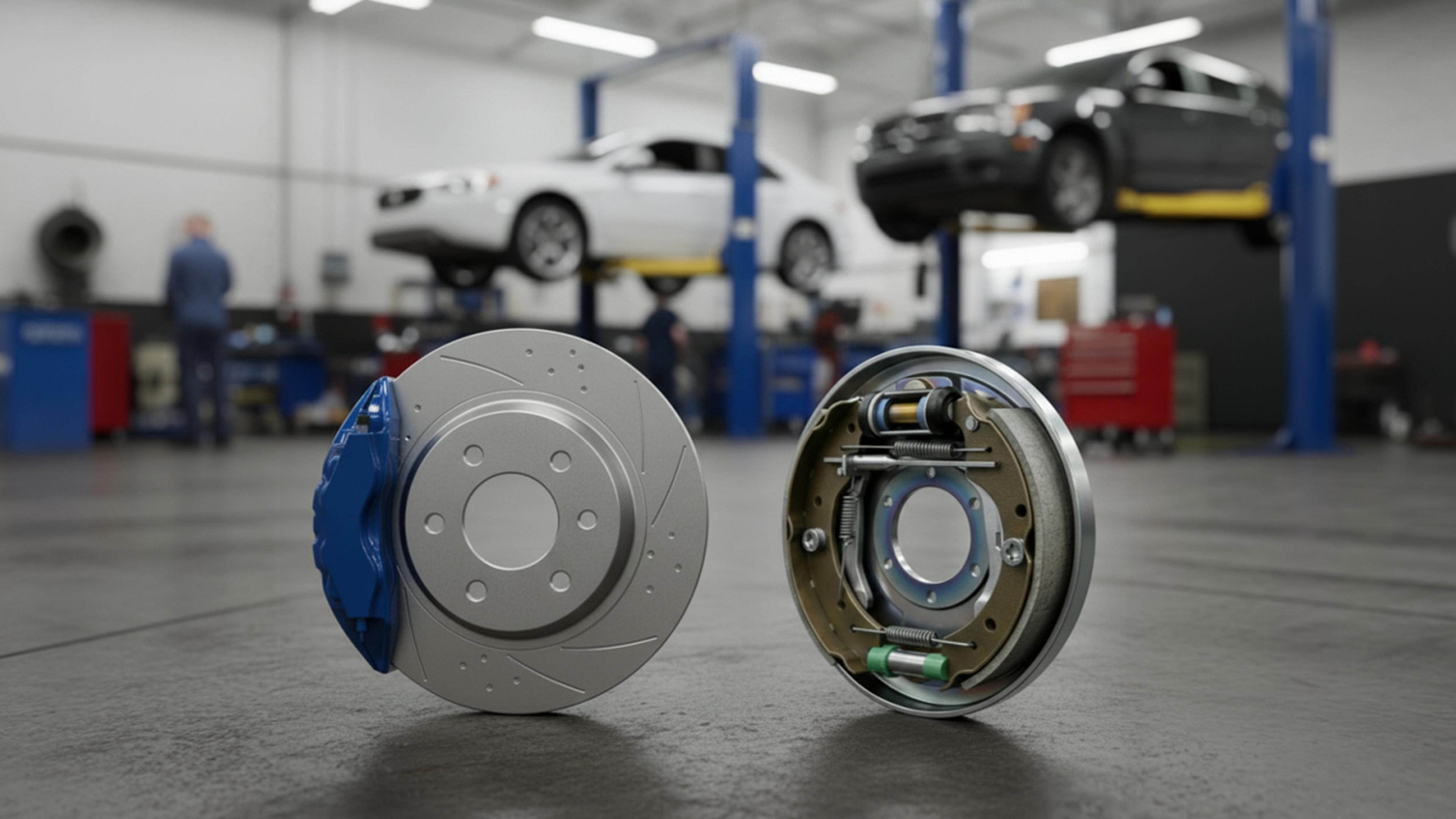
In disc brakes, brake pads take on the role of brake shoes. They are pressed against a rotating brake disc from the outside by one or more pistons in the brake caliper. This frictional contact produces a very even and controllable braking effect.
Key differences from drum brakes
The disc brake differs from the drum brake in several fundamental ways, offering noticeable advantages for modern braking systems. While friction in a drum brake is generated internally by pressing the brake shoes against the closed brake drum, the braking force in a disc brake acts externally, directly on the rotating brake disc. This open design significantly improves heat dissipation, so that the braking effect remains much more stable even during long descents or repeated braking maneuvers. In a closed braking system such as the drum brake, on the other hand, heat can build up more quickly, which reduces performance and can lead to fading.
Another important difference lies in the controllability. Thanks to the precision of the brake caliper, the braking force of disc brakes can be transmitted much more directly, evenly, and in a more controlled manner. This results in a more refined response and better overall control of the entire braking system. Mechanically, too, disc brakes are simpler and more transparent in design, as they do not require complex lever mechanisms or adjusters like drum brakes. This modern design ensures that the braking system delivers consistently reliable braking performance under various conditions, whether in wet weather, high temperatures, or under heavy loads.
Advantages of disc brakes over brake shoes
Compared to classic drum brakes with brake shoes, disc brakes offer significant performance and safety advantages. The open design of disc brakes allows heat to dissipate much more quickly, which keeps the braking effect stable even during frequent or intensive braking. This improved heat dissipation significantly reduces the risk of brake fade, a clear advantage for modern braking systems. In addition, the direct-acting caliper enables precise, consistent response, giving the driver a controlled pedal feel at all times. Maintenance work such as changing or checking the brake discs is also easier to carry out, as all parts are clearly visible and quickly accessible. The reduced susceptibility to corrosion of the brake discs, which dry quickly after rain or snow, further increases the reliability of the entire braking system. This is why disc brakes are now the preferred choice in vehicles that require high braking performance, such as passenger cars, electric vehicles, vans, and sports models.
Why drum brakes still exist
Despite the many advantages of disc brakes, brake shoes and classic drum brakes continue to have their place in modern braking systems. The open design of disc brakes leads to better braking performance, but at the same time makes them more susceptible to dirt, moisture, and road salt, which can increase wear. In addition, brake discs and calipers are more precise to manufacture and therefore more cost-intensive. One technical advantage of drum brakes remains their self-reinforcement. Because the brake shoes are easily "pulled" into the rotating drum when pressure is applied, this braking system requires less hydraulic pressure, which makes it particularly efficient. Mechanical parking brakes can also be integrated more easily and reliably into a drum brake. For these reasons, despite its lower continuous braking performance, the drum brake remains a sensible and robust solution on the rear axle of many small cars and hybrids.
Conclusion
Brake shoes are a central element of the drum brake and play an important role in modern braking systems. They significantly determine the braking effect and contribute to the even deceleration of the vehicle. In conjunction with the other components of the braking system, they ensure safety, stability, and controlled braking behavior. Anyone who understands the function and importance of brake shoes will quickly realize why they are still an indispensable part of many braking systems today.