How does the drum brake work in a vehicle?
The drum brake is one of the most traditional types of brakes in cars and is still used in many vehicles today—especially on the rear axle. It ensures that a vehicle decelerates in a controlled manner, comes to a safe stop, and reliably shortens the braking distance. Although drum brakes are still an integral part of modern braking systems, many drivers do not know exactly how brake shoes and brake drums work together and why this design still has its advantages today.
As a closed braking system, the drum brake uses mechanical and hydraulic principles to ensure consistent and stable braking performance. The design and function of the drum brake show why this type of brake continues to be used despite modern alternatives.
Function of the drum brake
The function of the drum brake is to reduce the kinetic energy of the vehicle in a controlled manner and convert it into heat. The brake shoes inside the brake drum press outward, creating friction that slows down the wheel. The braking process begins as soon as the driver presses the pedal and pressure builds up in the hydraulic system. This pressure acts on the wheel brake cylinder, which pushes the brake shoes apart. The friction between the brake shoes and the brake drum slows down the rotation of the wheel – the braking distance is shortened and the vehicle is slowed down in a controlled manner.
Thanks to its closed design, the drum brake delivers consistent, easily modulated braking power and works reliably even in the presence of dirt or moisture. Many braking systems make specific use of these properties on the rear axle.
Design of the drum brake
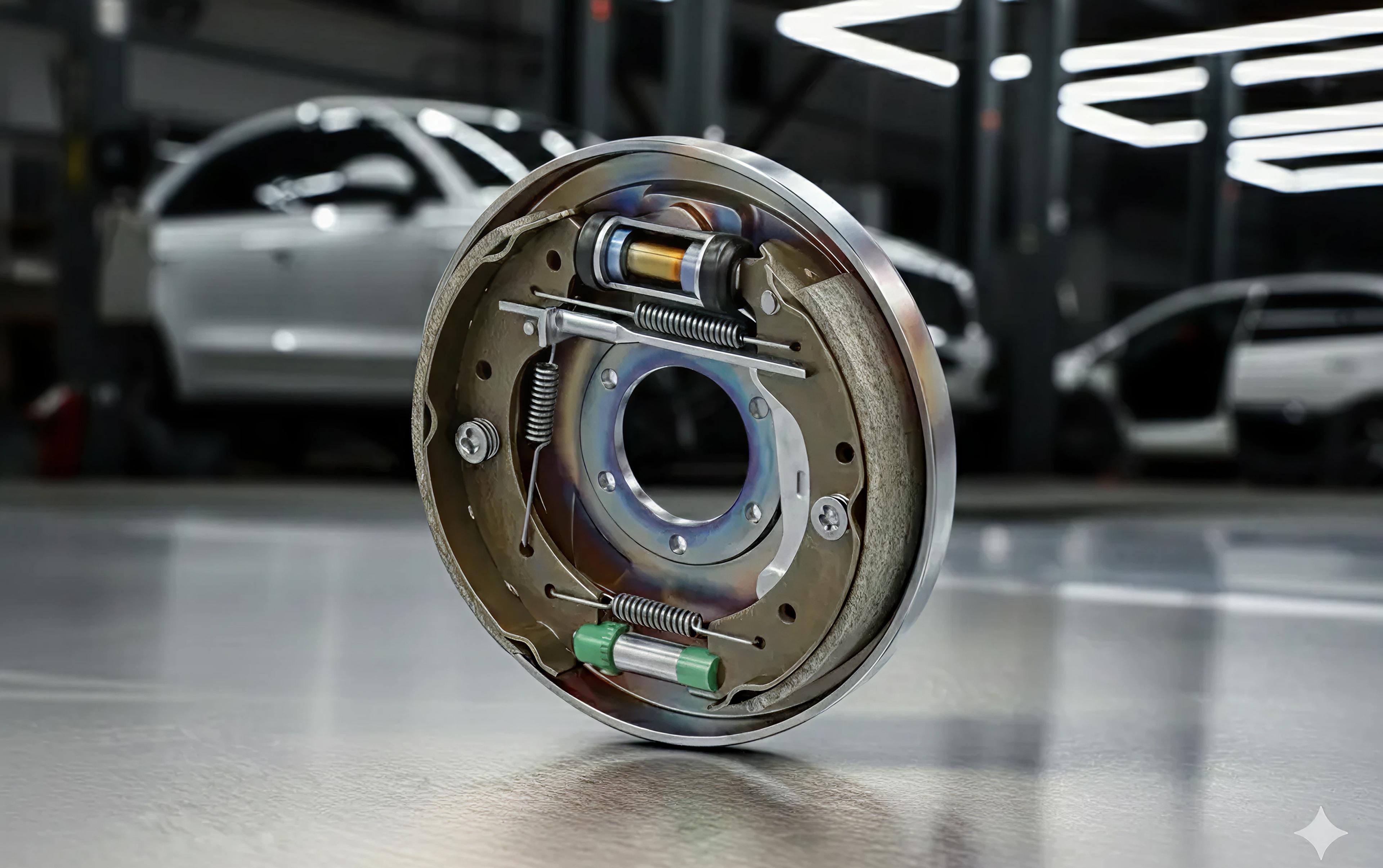
A drum brake is a closed brake system in which all important components are protected inside. The central component is the brake drum, which is firmly connected to the wheel hub and rotates together with the wheel. The entire brake mechanism is located inside. There are two curved brake shoes with friction linings, which are attached to a sturdy carrier plate. One or more wheel brake cylinders are also located on this plate. When the brake is applied, these cylinders press the brake shoes evenly against the rotating drum from the inside, creating the braking effect. After braking, return springs pull the brake shoes back to their original position so that they do not rub against the drum continuously. Adjustment devices ensure that the distance between the shoes and the drum remains constant and that the brake responds reliably. The closed design protects the mechanism well against dirt, water, and salt, which keeps it functioning stably, especially in wet conditions. One disadvantage of this design is that heat can build up in the drum during intensive braking, as it is only dissipated to the environment to a limited extent. For this reason, modern brake drums are often equipped with ribs or ventilation openings to dissipate heat more effectively.
Overall, the design of the drum brake offers robust and durable braking performance, but requires special attention in terms of temperature development under high loads.
Key components of the drum brake
Brake drum
The brake drum is directly connected to the wheel and rotates with every movement of the vehicle. It is usually made of cast iron or steel and, together with the brake shoes, forms a friction pair that slows down the rotational movement of the wheel. During braking, the brake shoes press against the smooth cylindrical inner surface of the drum from the inside and convert kinetic energy into heat.
The brake drum must withstand high mechanical loads and temperatures. Its mass and material properties have a significant influence on its temperature resistance and braking performance. Because the drum has to absorb and dissipate the heat generated, continuous loading can cause it to heat up significantly and expand slightly, which can temporarily reduce the braking effect (brake fading).
In normal operation, however, the brake drum ensures uniform deceleration and, thanks to its closed shape, protects the internal components from external influences.
Brake shoes
The brake shoes are curved carriers with friction linings attached to them. They sit on the inside of the anchor plate and are pressed outwards against the drum by the wheel cylinder when braking. The friction material of the linings has a multi-layer structure and is selected so that it can withstand high temperatures and friction forces without wearing out too quickly.
Unlike disc brake pads, drum brake pads are less prone to "glazing" under lower loads – an effect in which the surface hardens due to infrequent heavy braking and loses its effectiveness.
Worn brake shoes can significantly reduce braking performance, increase braking distances, and cause vibrations or squeaking noises. Regular checks and timely replacement of the pads are therefore important for the safety and efficiency of the braking system.

Wheel brake cylinder
The wheel brake cylinder is the hydraulically operated actuator of the drum brake. It is usually located at the upper end of the two brake shoes and contains one or two pistons that move outward when pressure is applied by the brake fluid. This spreads the brake shoes symmetrically against the drum and generates the necessary braking force.
In simple designs (simplex drum brakes), a wheel cylinder with two pistons is sufficient for both shoes; more complex systems may have several cylinders.
The wheel brake cylinder is crucial for the direct conversion of brake pedal pressure into mechanical braking action. A cylinder that works properly ensures that the brakes respond evenly, thus ensuring driving stability during deceleration. Leaks or stuck pistons can significantly impair the braking effect; in the worst case, the brake on one side may fail partially, which can lead to dangerous pulling of the vehicle to one side. Therefore, during maintenance work, particular attention must be paid to the tightness and mobility of the wheel cylinders.
Other components
Other important components of a drum brake are the anchor plate (also known as the brake carrier plate), which serves as a stable base carrier and protects the mechanism from dirt and heat. In addition, there are return springs, which pull the brake shoes back to their original position after braking, and the adjustment mechanism, which automatically regulates the distance between the brake lining and the brake drum. Together, these elements ensure precise, reliable, and low-friction movement inside the brake drum.
Safety systems related to the drum brake
Modern vehicles often combine drum brakes with electronic assistance systems to improve braking performance and driving stability. The anti-lock braking system (ABS) prevents the wheels from locking by rapidly reducing and increasing the hydraulic pressure in the wheel brake cylinder. This allows the vehicle to remain steerable even during emergency braking with drum brakes, and the wheels maintain sufficient grip on the road.
The electronic stability program (ESP) continuously monitors the vehicle's movement and intervenes when there is a risk of skidding. It can selectively brake individual wheels – regardless of whether they are equipped with disc or drum brakes – to keep the vehicle stable in its lane.
Brake assist detects emergency braking and ensures that the wheel brake cylinder immediately applies maximum pressure, even if the brake pedal is not fully depressed. All these systems work unobtrusively in the background, making the drum brake an integral part of modern, electronically controlled vehicle safety.

Maintenance of the drum brake as the basis for reliable safety
Even a robust drum brake can only achieve its full braking performance if all components are regularly checked and maintained. Although drum brakes are comparatively low-wear and have a long service life, their maintenance is easily neglected in everyday use.
Over time, brake pads wear down and lose their effectiveness. Brake drums can become grooved or warped due to heavy use. The wheel brake cylinder and mechanical components, especially return springs and adjusters , also require regular maintenance.
What happens when return springs are worn?
Return springs pull the brake shoes back to their original position after braking. If they are too weak or damaged, the following problems may occur:
- Brake shoes constantly rub lightly against the drum, leading to increased wear, overheating, and poorer braking performance.
- Uneven springback, causing one side to brake faster than the other.
- Unstable handling, especially when braking from higher speeds.
What are the disadvantages of a poorly functioning adjuster?
The adjuster automatically regulates the distance between the brake lining and the brake drum. If it is stiff or blocked, the following risks arise:
- Extended pedal travel because the brake shoes have to travel too far before they engage.
- Uneven brake force distribution when one brake shoe engages earlier than the other.
- Reduced braking performance, especially during sudden or heavy braking maneuvers.
- Noise and vibrations because the jaws do not fit together optimally.
A defective adjuster is one of the most common causes of a drum brake that feels "soft" or responds slowly.
During inspections, the workshop therefore usually checks the condition and function of the drum brakes. If there are signs of reduced braking performance, such as longer pedal travel, reduced deceleration, or unusual noises, a specialist workshop should be visited as soon as possible.
Replacing components in drum brakes is more complex than in disc brakes and should only be carried out by trained specialists in accordance with the manufacturer's specifications. Professional and regular maintenance ensures that the braking system remains reliable, safe, and effective in the long term.
Why drum brakes are still relevant
Development
In the early years of automobile manufacturing, drum brakes were standard on both the front and rear axles. Their simple functionality and braking power, which was sufficient for the vehicles of the time, made them the preferred solution. However, as demands on braking performance and heat resistance increased, disc brakes became increasingly popular on the front axle. Their higher heat tolerance and more consistent response were the deciding factors for the front axle.
On the rear axle, however, drum brakes were long considered sufficient, as the vehicle's weight shifts significantly forward during braking, meaning that the rear wheels require less braking force. The advantages of drum brakes – low cost, simple design, and high robustness – played a major role here for a long time. It was only increasing demands on safety and performance (for example, in luxury cars, sports cars, or when towing heavy loads downhill) that gradually made disc brakes attractive for the rear as well.

Advantages Durability
- Long service life and low maintenance: Drum brakes impress with their extremely long brake lining service life and low wear. The brake shoes of a drum brake often last significantly longer than the pads of a disc brake. As a result, drum brakes require less frequent maintenance and fewer parts need to be replaced. Many manufacturers only require cleaning of the brake drums and inspection of the pads at longer intervals. The longer maintenance intervals mean fewer visits to the workshop and lower operating costs.
- Protected design without "wetness effect": The closed design of the brake drum shields the brake mechanism from water, dirt, and salt. Weather conditions therefore have little effect on braking performance. Unlike open disc brakes, there is no noticeable "wet effect" when driving through rain or puddles – the drum brake engages without delay even in wet conditions. In addition, hardly any brake dust escapes to the outside, which reduces contamination of the rims and ensures lower fine dust emissions.
Advantages of braking force
- Self-reinforcement for high braking force: Drum brakes use structural self-reinforcement. This means that the friction force is partially reinforced automatically as soon as the brake drum rotates and the brake shoes are applied. As a result, only relatively low pedal forces are required to achieve strong deceleration. In the past, this feature meant that light vehicles did not even need a brake booster. Even today, it results in a particularly favorable ratio of pedal force to braking effect.
- Cost-effective and reliable:
Drum brake technology has been tried and tested over decades and is relatively simple, which makes it very reliable. At the same time, drum brakes are cheaper to manufacture than disc brakes. This price and reliability argument is particularly important in small and compact cars as well as commercial vehicles. - Consistent braking performance in everyday use:
In normal everyday use, drum brakes deliver consistent, predictable braking performance. Particularly in vehicle classes where extreme emergency braking is rare, they offer a good balance between performance, durability, and cost. This balance between performance and durability is one of the main reasons why drum brakes continue to be used in vehicle construction despite the widespread use of disc brakes.
Conclusion
The drum brake remains an important braking system in vehicles, having proven itself to be reliable, durable, and versatile through decades of further development. The interaction of the brake drum, brake shoes, and wheel cylinder enables controlled and effective deceleration of the vehicle. Their enclosed design, low maintenance requirements, and robust function make them particularly attractive for rear axles and special applications. When properly maintained, drum brakes offer solid safety, high load capacity, and consistent braking performance, a decisive advantage for all drivers who need to rely on their brakes.