How do disc brakes work in a vehicle?
Today, disc brakes are one of the most important safety-related systems in cars. They ensure that a vehicle decelerates reliably, comes to a safe stop, and remains controllable even in critical situations. Although disc brakes are used in almost all modern vehicles, many drivers do not know exactly how brake discs, brake pads, and brake calipers work together and why this design offers advantages over other braking solutions.
As an open, high-performance system, the disc brake combines mechanical, hydraulic, and thermal properties that are crucial for precise braking. The design and function of the disc brake clearly demonstrate why it plays a central role in the braking system of a car and has become the global standard.
Function of the disc brake
The sole purpose of the disc brake is to convert the kinetic energy of the vehicle into heat in a controlled manner, thereby reducing its speed or bringing it to a halt.
When braking, the driver applies pressure to the brakes, generating a force that presses the brake pads against the rotating brake disc. The resulting friction reduces the speed of the wheel until the desired deceleration is achieved.
In addition, disc brakes contribute to vehicle stability by providing consistent, easily controlled braking force. They enable short reaction times, precise braking feel, and consistent braking performance—even at high speeds, during intense braking maneuvers, or in changing weather conditions.
Disc brake design
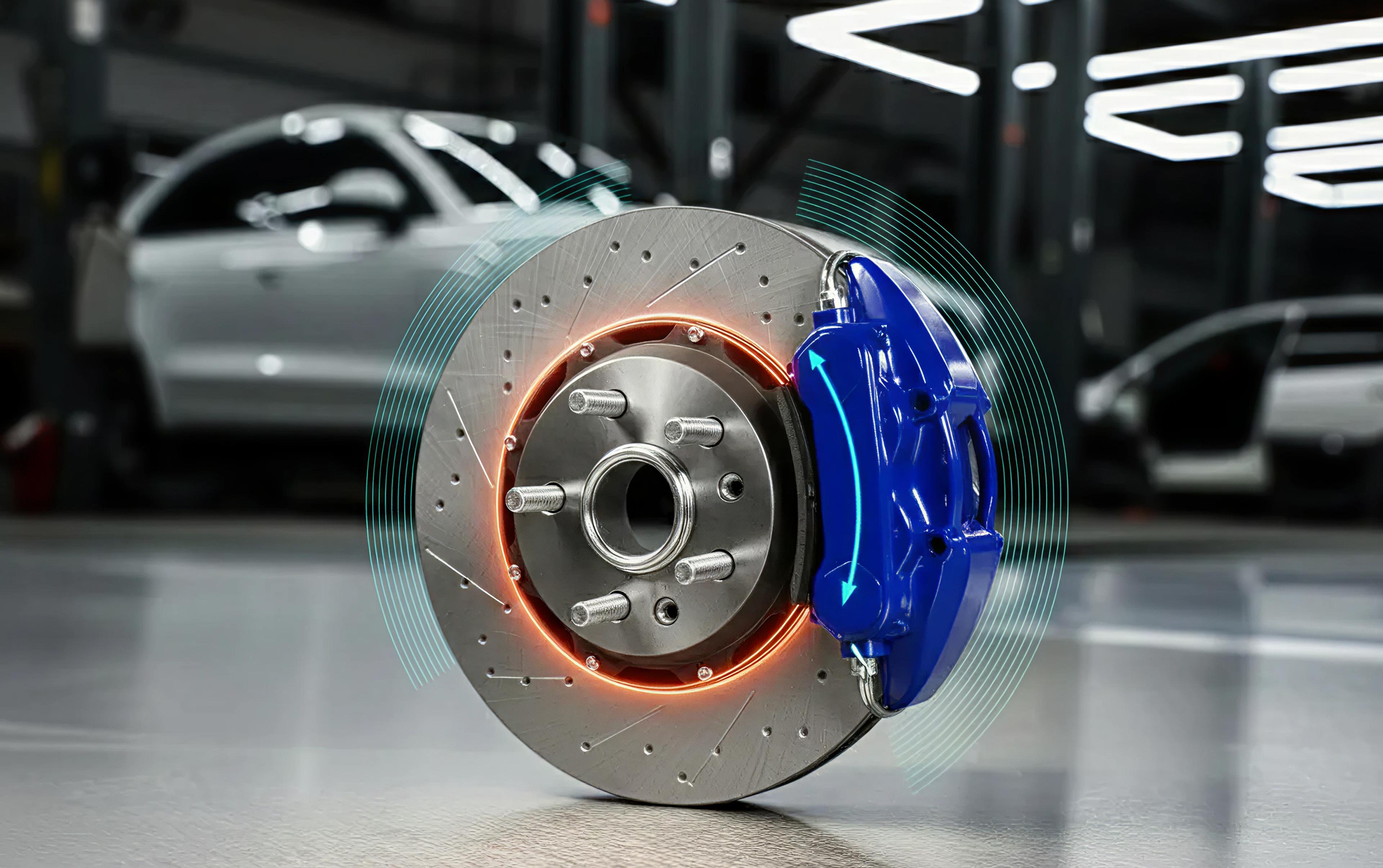
A disc brake is designed as an open, well-cooled braking system and consists of several precisely coordinated components. At the center is the brake disc, which is firmly connected to the wheel hub and rotates with the wheel. This disc is usually made of steel or composite material and, depending on the vehicle type, may be ventilated, perforated, or slotted to dissipate heat more quickly.
The brake caliper is attached to the axle or steering knuckle and partially surrounds the brake disc. It contains pistons that are controlled by hydraulic pressure. When the brake is applied, these pistons press the brake pads evenly against the rotating brake disc from both sides.
It is secured using sturdy screw connections that must be able to withstand high forces and intense heat. Heat-resistant guides, seals, and sliding surfaces are used between the components to ensure precise and low-friction movement.
The open design ensures that frictional heat can escape efficiently, the pads are evenly applied, and the brake system remains stable even under heavy use. At the same time, it improves the cleaning effect of the airflow and reduces the risk of thermal overload.
Key components of the disc brake
Brake discs
The brake discs are directly connected to the wheel hub and rotate with every movement of the vehicle. They are usually made of cast iron, steel, or modern composite materials that have high thermal conductivity. The disc brake has an open design, which allows the frictional heat generated during each braking maneuver to be quickly dissipated into the environment. Depending on the application, different designs are used, such as ventilated brake discs, perforated discs, or slotted variants. These designs enable even more efficient heat dissipation and reduce the risk of "fading," i.e., the reduction in braking performance under high thermal loads. The brake disc is therefore the central friction partner of the brake pads and significantly determines the stability, temperature resistance, and deceleration performance of a disc brake.
Brake pads
The brake pads are located in the brake caliper and consist of a multi-layer friction material that must withstand high temperatures, friction coefficients, and mechanical stress. When the brake is applied, they are pressed against the brake disc with controlled pressure. The resulting friction contact converts kinetic energy into heat and provides the actual braking effect. The composition of the pads, for example organic, metallic, or ceramic, influences both braking performance and noise behavior, wear, and temperature stability. Worn brake pads can significantly reduce braking performance, increase braking distances, and lead to vibrations or squeaking noises. Regular checks and timely replacement are therefore essential for the safety and efficiency of the entire braking system.

Brake caliper
The brake caliper is the central moving element of the disc brake and is responsible for pressing the brake pads evenly against the rotating disc. It partially surrounds the brake disc and contains one or more hydraulically operated pistons that generate the required braking force. A distinction is made between fixed calipers and floating calipers. Fixed calipers have several pistons on both sides of the disc and enable particularly even pressure distribution. They are often used in sporty or powerful vehicles. Floating calipers have pistons on only one side and move slightly during braking, which makes them lighter and less expensive. The brake caliper is crucial for the direct conversion of hydraulic pressure, for the stability of the braking process, and for the efficiency of energy conversion. A correctly functioning brake caliper ensures clean response, precise controllability, and reliable deceleration in all driving situations.
Tips for purchasing brake components
When purchasing brake parts, special care is required, as brakes are among the most safety-relevant components of a vehicle. To ensure that new parts function reliably, a few basic points should be observed.

Accurate fit and correct vehicle assignment
Brake discs and brake pads must fit the vehicle exactly. There are differences even within a model series, depending on the engine or brake system type, for example. Therefore, the vehicle key number or chassis number should be used for identification. Only correctly dimensioned parts—suitable disc thickness, diameter, design (ventilated or not) and existing sensors—guarantee the braking performance that the vehicle requires.
Quality and certification
When purchasing, you should only use tested products, ideally with ECE-R90 certification. This standard ensures that replacement parts offer comparable braking performance to original parts. Very cheap, untested no-name products are strongly discouraged, as they wear out faster, cause noise, or can impair braking performance. Brand manufacturers such as ATE, Bosch, Brembo, and TRW offer reliable quality and tested safety.
New or replacement part for the brake caliper
Brake calipers are available as new parts or as professionally reconditioned replacement parts. The latter are often significantly cheaper and are refurbished with new seals, guides, and pistons. They generally offer the same functionality as a new component. It is important to note the old part deposit and return the old caliper. For consistent braking performance, always check or replace both axles.
Replace brake discs and brake pads together
Discs and pads should almost always be replaced at the same time and on the same axle. New pads on old discs (or vice versa) cause uneven wear and longer braking distances. In addition, there are prescribed minimum thicknesses for brake discs, below which replacement is mandatory. Many pads come with mounting kits or sensors already included, which makes installation easier.
Installation and correct running-in
Brake work should only be carried out by professionals or experienced mechanics. New discs must be degreased before installation, and screws must be tightened to the correct torque. After replacement, the brakes should be run in moderately for approx. 200–300 km so that the discs and pads fit together optimally and full braking performance is achieved.
Further purchase considerations
Depending on the vehicle, additional criteria may be important:
- suitable wear sensors
- Treads with higher temperature resistance for athletic use or trailer operation
- Low-dust coatings for clean rims
- Coated brake discs for protection against rust
Disc brake construction
Floating caliper vs. fixed caliper
The floating caliper is the most commonly used design in passenger cars. It has one or two pistons on one side of the brake disc and moves slightly during braking so that both brake pads apply equal pressure. This makes it cost-effective, reliable, and relatively low-maintenance.
Fixed calipers, on the other hand, are rigidly mounted and have pistons on both sides of the disc. This multi-piston arrangement results in a particularly even distribution of pressure, which increases braking power and makes the pedal feel more direct. They are often used in high-performance vehicles. However, fixed calipers are more expensive, larger, and more complex to maintain. Both systems serve the same purpose, but differ significantly in performance and cost.
Solid vs. internally ventilated brake discs
Solid discs are solid brake discs without cavities. They are more robust, cheaper, and sufficient for rear axles or light vehicles. Internally ventilated brake discs, on the other hand, consist of two friction rings connected by bridges. This design creates air channels that allow a constant flow of air while driving. This dissipates heat more quickly, preventing overheating and maintaining stable braking performance even during frequent or heavy braking. Internally ventilated discs are therefore now standard on front axles. When replacing discs, it is essential to use the type specified by the manufacturer.
Perforated and slotted brake discs
Perforated and slotted brake discs have small holes or milled grooves in the friction surface. These are designed to dissipate water and abrasion more quickly and promote a clean brake pad surface. They can be particularly advantageous in sporty driving or at high temperatures, as they reduce fading and improve responsiveness.
However, their benefits are limited for normal road use. Such discs can be noisier, lead to faster pad wear, and even develop cracks if they are of inferior quality. Therefore, perforated and slotted variants should only be used if they are manufactured to a high standard and have been tested accordingly.
Materials and variants of brake pads
Brake pads differ in terms of friction material, temperature behavior, and noise generation. Organic or semi-metallic pads are usually fitted as standard, as they offer a good balance between performance, cost, and comfort.
Sintered metal or ceramic pads are available for sports cars. These can withstand higher temperatures, generate less dust, and maintain their braking effect even under extreme loads. However, they can be louder at low temperatures or produce a harder braking feel. Many modern vehicles have wear sensors in the pads that warn the driver in good time when a replacement is due.
Size and material of the components
The size of the brake discs and the design of the calipers vary significantly depending on the vehicle class. Small vehicles often use discs with a diameter of around 240 mm, while large SUVs or high-performance vehicles use discs over 350 mm with four or six-piston calipers. Larger discs mean more friction surface, higher temperature reserves, and shorter braking distances.
In the tuning or performance sector, larger brake systems are therefore often retrofitted, but only if they are technically and legally approved. In terms of materials, gray cast iron discs and steel or aluminum calipers dominate. Due to their extreme cost and special requirements, carbon-ceramic systems are mainly reserved for sports and luxury models.
Safety systems related to disc brakes

Electronic assistance systems
Modern vehicles combine disc brakes with various electronic assistance systems that significantly improve braking performance, stability, and control. The anti-lock braking system (ABS) prevents the wheels from locking by precisely regulating the hydraulic pressure on the brake discs and brake pads. This allows the vehicle to remain steerable even during emergency braking. The electronic stability program (ESP) monitors the vehicle's movement and intervenes if instability threatens. It brakes individual wheels in a targeted manner via the disc brakes, thus stabilizing the vehicle in curves or during abrupt evasive maneuvers. Brake Assist detects emergency braking and ensures that the brake caliper immediately applies maximum pressure to the brake disc – even if the driver does not fully depress the pedal. These systems work continuously in the background, making the disc brake a state-of-the-art, intelligently controlled safety feature in the vehicle.
Disc brake maintenance as the basis for reliable safety
Even the most powerful disc brake can only deliver its full braking power if all components are regularly checked and serviced. Brake pads wear out over time and thus lose their effectiveness, while brake discs can wear out or warp under heavy loads. The brake caliper also needs care: if it is not cleaned and lubricated regularly, it can lose its mobility and cause uneven or delayed braking. Careful maintenance therefore ensures that the entire braking system remains reliable, safe, and durable.
Typical maintenance measures include:
- Regular inspection of brake pads
- Measuring the thickness and condition of brake discs
- Checking the mobility and tightness of the brake caliper
- Replacement of worn or damaged components
Typical areas of application for disc brakes
Development
Disc brakes are now used on the front axle of almost every modern vehicle and are increasingly being installed on the rear axle as well. Their high braking power, excellent heat dissipation, and precise controllability make them the preferred solution for everyday vehicles, high-performance models, and heavy vehicles alike. In the past, however, disc brakes were rarely used on the rear axle. The main reason for this is brake force distribution: when braking, the vehicle weight shifts significantly to the front, which means that the front axle takes on most of the braking work. Drum brakes were therefore long considered sufficient for the rear axle. They were cheaper to manufacture, offered enough braking power for the lower load, and were particularly robust and low-maintenance due to their closed design. It was only increasing demands on safety, performance, and temperature stability that made disc brakes more attractive for the rear as well.
Advantages of disc brakes
Today, vehicles on both axles benefit from the strengths of disc brakes. They offer high thermal resistance, consistent braking performance even under intensive use, and a direct, finely controllable braking feel. Large brake discs, high-quality brake pads, and powerful multi-piston brake calipers are indispensable, especially in vehicles with high performance, heavy bodies, trailer operation, or sporty design.
Another advantage of disc brakes is their open design. They dissipate heat particularly effectively, which means that brake fade occurs much less frequently than with closed brake systems. They also accumulate less dirt, which keeps the braking effect stable in the long term and reduces maintenance costs. The even distribution of force across the brake discs also ensures that the vehicle decelerates precisely and in a controlled manner, even under high loads.
But disc brakes also offer decisive advantages in everyday road traffic. They respond evenly, remain stable in wet conditions, and offer reliable braking performance at any speed. Their direct response gives the driver a very controlled braking feel, which is particularly important in dangerous situations. These characteristics make disc brakes one of the central components of modern vehicle and safety concepts — powerful, reliable, and versatile.
Conclusion
The disc brake is one of the most important systems in a modern vehicle. The interaction of brake discs, brake pads, and brake calipers enables precise, consistent, and highly effective braking performance. Their open design, strong heat dissipation, and reliable function make them the preferred braking solution in cars. When properly maintained, disc brakes offer maximum safety, high load capacity, and direct, controlled braking performance—a decisive advantage for all drivers who need to rely on their brakes.