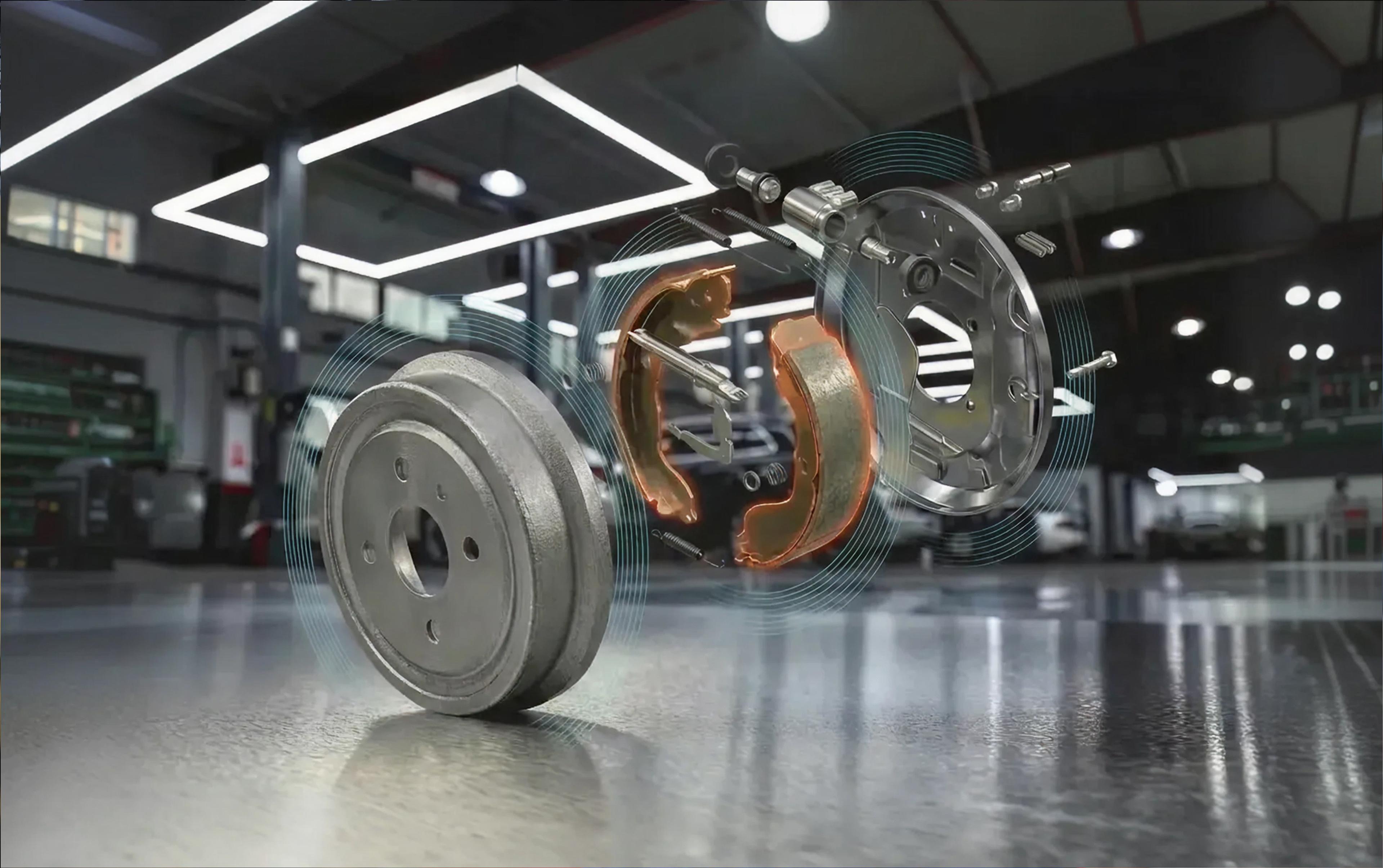
Brake components at a glance
Modern vehicles rely on the precisely coordinated interaction of numerous brake components. Whether in city traffic, on the highway, or during emergency braking, the brake system must function reliably at all times. It is not individual components, but the interaction of brake pads, brake discs, brake calipers, brake shoes, and brake drums that determines safety, braking distance, and driving feel.
This overview shows how modern braking systems are constructed, what components they consist of, and what role they play within the braking system.
Brake systems as a basis
Hydraulic braking systems
Modern vehicles are almost without exception equipped with hydraulic braking systems, as these enable reliable and precise power transmission. When the brake pedal is pressed, the brake fluid in the master brake cylinder is pressurized and fed to the brake system via a closed pipe system. At the wheels, the system converts this hydraulic energy into mechanical braking force by pressing brake pads against brake discs or brake shoes against brake drums. The resulting friction ensures controlled deceleration of the vehicle and forms the basis for safe braking in all driving situations.
Interaction of brake components for safe braking
Depending on the vehicle design and load, different types of brakes are used in modern braking systems. Disc brakes with powerful calipers are often installed on the front axle, while drum brakes with brake shoes and brake drums are used on the rear axle. Both systems meet different requirements and complement each other well in many vehicles. However, the precise interaction of all components is crucial for the functioning of the entire brake system. Only when brake pads, brake discs, brake drums, brake shoes, and brake calipers are precisely matched to each other can the braking effect be uniform, controllable, and permanently reliable.
Brake components in disc brakes
Disc brakes are now one of the most important braking systems in modern vehicles and are standard on the front axle of almost all passenger cars, SUVs, and commercial vehicles. Their biggest advantages are their high braking performance, good cooling, and very precise controllability of the braking force. The open design allows heat to dissipate quickly, enabling consistent braking performance even during repeated braking maneuvers. Disc brakes respond directly to pedal input and can be finely controlled, making them particularly safe at high speeds.
Disc brakes are primarily used where high deceleration forces occur, such as on the front axle, as most of the vehicle load shifts forward when braking. The main disadvantages are higher wear and tear during intensive use and greater susceptibility to dirt, moisture, and corrosion compared to closed systems such as brake drums. Nevertheless, disc brakes are now at the heart of many braking systems and have become an indispensable part of modern braking systems.

Brake pads
Brake pads are classic wear parts within the disc brake system and play a central role in the overall braking effect. When the brake pedal is pressed, they are pressed against the rotating brake disc via the brake calipers. This direct friction contact converts the vehicle's kinetic energy into heat, causing the vehicle to slow down or come to a stop.
The material composition of brake pads is crucial to the performance of the braking system. Modern pads are made of complex composite materials that may contain fibers, resins, metallic components, or ceramic particles. This mixture influences the coefficient of friction, temperature resistance, noise, and wear behavior. High-quality brake pads ensure even power transmission, reduce vibrations, and at the same time protect brake discs and calipers from excessive abrasion. Inferior or heavily worn pads, on the other hand, can lead to uneven braking, longer braking distances, or annoying noises.
Brake discs
Brake discs are the direct friction partner of the brake pads and contribute significantly to the thermal stability of the brake system. They absorb the heat generated during braking and release it into the ambient air. Depending on their design—solid disc, internally ventilated disc, slotted or perforated version—brake discs are designed for different loads.
Internally ventilated brake discs have air channels between two friction rings, which improve air flow and increase cooling performance. Slotted or perforated brake discs also help to dissipate gases, water, and brake dust, which enables more stable friction behavior, especially during sporty driving or under high loads. High-quality brake discs are made of specially alloyed cast materials or composite materials that remain dimensionally stable even at high temperatures. Deformations, grooves, or heat cracks significantly impair braking performance and have a direct impact on the entire braking system.
Brake calipers
Brake calipers connect the hydraulic part of the brake systems with the mechanical braking effect on the disc brake. They hold the brake pads and contain the brake pistons, which are moved by the hydraulic pressure of the brake fluid. As soon as the driver presses the brake pedal, the pistons press the brake pads against the brake discs in a controlled manner.
Depending on the design, a distinction is made between fixed and floating brake calipers. Both systems perform the same task, but differ in their construction and movement. The free movement of the brake calipers and their guides is crucial for the functioning of the entire brake system. Corrosion, dirt, or stuck pistons can cause the brake pads to not apply evenly or to not retract completely. This results in uneven wear, increased temperatures, and a noticeable reduction in braking performance. Since brake calipers work directly with all other brake components, even minor malfunctions have an immediate effect on the performance of the entire brake system.
Differentiation from brake drums and brake shoes
Unlike disc brakes, brake drums and brake shoes operate in a closed system. Here, the brake shoes press outwards against the inner surface of the drum. This design is more robust against external influences and is often used on the rear axle. However, heat dissipation is limited in brake drums, which is why their braking effect can diminish more quickly under high continuous loads. In modern braking systems, disc brakes on the front axle and drum brakes on the rear axle often complement each other well in order to optimally balance efficiency, durability, and cost.
Brake components for drum brakes
Drum brakes are an integral part of many modern braking systems and are primarily used on the rear axle of numerous vehicles. Their greatest advantage lies in their enclosed design, which reliably protects the entire braking system from dirt, moisture, and corrosion. As a result, drum brakes are characterized by high durability and comparatively low maintenance requirements. They offer a robust and economical solution, especially for vehicles whose rear axle has to provide less braking power.
Another advantage of the drum brake is its consistent braking effect under moderate loads and the easy integration of the parking brake into the existing brake system. The main disadvantages are the limited heat dissipation. Since the brake drum forms a closed system, heat can build up more quickly during intensive use than with open disc brakes. Drum brakes are therefore mainly used in applications where continuous loads are lower and high durability is more important than maximum braking performance.

Brake drums
Brake drums form the outer housing of the drum brake and are firmly connected to the wheel hub. They rotate together with the wheel while driving and provide the friction surface where deceleration occurs. Inside the brake drum, the brake shoes press against the precisely machined inner surface, converting the vehicle's kinetic energy into heat.
Brake drums are usually made of solid cast iron or special cast alloys that can absorb high mechanical loads and thermal stresses. The material must remain dimensionally stable, as even slight deformations can lead to uneven braking, vibrations, or delayed response. The closed design effectively protects the internal components of the brake system from external influences, which is a major advantage, especially during longer downtimes or infrequent use. At the same time, however, this design makes heat dissipation more difficult, which is why the thermal load capacity of the brake drum plays a central role in the functional reliability of the entire brake system.
Brake shoes
Brake shoes perform the same function in drum brakes as brake pads do in disc brakes. They are the actual friction partners and generate the braking effect through their contact with the inner surface of the brake drum. When the brake pedal is pressed, the hydraulic brake system builds up pressure, which is transmitted to the wheel brake cylinder via the brake fluid. This spreads the brake shoes outwards so that they press evenly against the drum.
The brake shoes consist of a sturdy carrier body and an applied friction lining. The friction lining is made of heat-resistant composite materials, the composition of which has a significant influence on braking performance, noise generation, and wear rate. High-quality brake shoes ensure even force build-up, smooth braking behavior, and a long service life for the entire brake system. However, if brake shoes are worn, glazed, or restricted in their mobility, the braking effect can become uneven.
Wheel brake cylinder
The wheel brake cylinder is the central hydraulic component within the drum brake and connects the brake system to the hydraulic pressure build-up of the brake system. It converts the pressure generated by the brake fluid into a mechanical spreading movement of the brake shoes. The pistons of the wheel brake cylinder must operate smoothly and be completely sealed to ensure even power transmission.
Corrosion, moisture, or aging of the seals can cause the wheel brake cylinder to become sluggish or lose pressure. In such cases, the brake shoes respond with a delay or unevenly, which manifests itself in increased pedal travel or reduced braking performance. Since the wheel brake cylinder has a direct influence on all downstream components, a defect has an immediate effect on the function of the entire drum brake.
Interaction of all brake components
In modern vehicles, brake components never work independently of each other. Each individual component is part of a complex system in which forces, movements, and temperatures must be precisely coordinated. Only when this interaction functions smoothly can the brake system deliver its full performance and ensure smooth, controllable deceleration.
With disc brakes, the brake pads must make contact with the brake discs evenly, while the brake calipers ensure that the hydraulic pressure is transmitted cleanly and symmetrically. Even minor faults, such as stiff brake calipers or unevenly worn brake discs, can lead to uneven braking performance, noise, or longer braking distances. The same principle applies to drum brakes: brake drums, brake shoes, and wheel brake cylinders must be precisely matched to each other so that the braking effect is built up evenly and is completely released after braking.
Uneven wear often occurs when individual components of the brake system are no longer working in harmony. Worn brake pads put excessive strain on brake discs, warped brake drums cause brake shoes to work unevenly, and stiff brake calipers impair pressure distribution throughout the entire brake system. Such chain reactions not only affect braking performance, but also increase wear on adjacent components.
For this reason, manufacturers and repair shops always consider braking systems to be a functional unit. During maintenance or repair, several components are therefore often checked or replaced together in order to restore balance within the braking system. Only the optimally coordinated interaction of all brake components ensures stable braking performance, short braking distances, and a safe driving experience in all driving situations in the long term.
Wear and maintenance of brake systems
Brake systems are among the most heavily used safety components in a vehicle. During daily operation, high temperatures, mechanical abrasion, moisture, dirt, and environmental influences simultaneously affect the individual components. Every time the brakes are applied, friction is generated, which not only slows down the vehicle, but also wears down material and generates heat. The strain on the braking system increases significantly, especially in city traffic with frequent stop-and-go driving, when driving downhill, or when carrying heavy loads.
Many wear processes are gradual and remain unnoticed for a long time. Increased pedal travel, slight vibrations when braking, or changes in noise levels are often the first signs that individual components are no longer working together optimally. It is not always immediately apparent which component is affected, as changes in one area can quickly affect the entire braking system.
Regular inspection of all brake components is therefore crucial for functional safety. If brake pads, brake discs, brake drums, brake shoes, and moving parts are checked in good time, consequential damage that would otherwise affect other areas of the brake system can be avoided. Uneven wear or seized components not only increase maintenance costs, but also noticeably impair braking performance.
Careful maintenance pays off in the long term. High-quality materials, precisely manufactured components, and coordinated interaction within the brake systems ensure consistent deceleration, stable braking performance, and a longer service life for the entire brake system. This keeps braking behavior predictable and safe, even under demanding driving conditions.
Signs of wear
- Squeaking/grinding noises when braking
- Noticeable vibrations or jerking in the brake pedal
- Extended braking distance or delayed response
- Unusually long pedal stroke
- Vehicle pulls to one side when braking
- ABS or ESP warning lights in the cockpit
Conclusion
Brake components form the safety-relevant heart of every vehicle. Whether disc brakes or drum brakes, modern braking systems only function reliably if all components are precisely coordinated with each other. Brake pads, brake discs, brake calipers, brake shoes, and brake drums each perform clearly defined tasks, but they are constantly interacting with each other. Even small deviations or wear on a single component can significantly alter braking performance, braking distance, and driving feel.
The overview shows that the braking system is not about isolated individual parts, but rather a finely balanced interplay of mechanics, hydraulics, and material quality. High-quality brake components ensure consistent power transmission, stable braking performance, and predictable response in all driving situations. Understanding the condition of your brake system and relying on coordinated components not only increases safety but also the longevity of the entire brake system.